
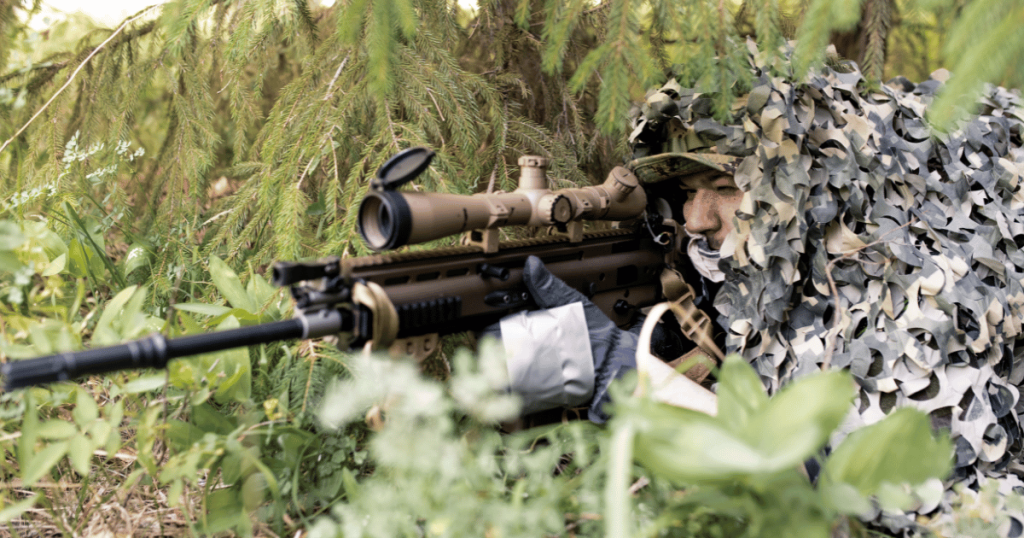
A rifle scope is not simply a magnified sighting device.
It is a precision-aligned optical-mechanical system that must maintain collimation under recoil, preserve image fidelity across variable magnification ranges, and deliver repeatable adjustment accuracy within tight tolerances.
Understanding how a rifle scope truly functions — from optical geometry to turret tracking mechanics — allows users to evaluate performance beyond marketing specifications.
This guide provides a comprehensive technical overview of rifle scope design, selection, and functional validation.
1. Optical System Architecture of a Rifle Scope
A rifle scope functions as a compact refracting telescope integrated with an internal reticle and mechanical adjustment system.
A typical optical path includes:
- Objective lens group
- Erector lens assembly
- Reticle plane (first or second focal plane)
- Ocular lens system
Each group serves a distinct optical purpose.
1.1 Objective Lens: Light Collection and Image Formation
The objective lens gathers incoming light and forms a real image inside the tube.
Two parameters determine its effective brightness contribution:
- Diameter (D)
- Magnification (M)
The exit pupil is calculated as:
Exit Pupil = Objective Diameter / Magnification
For example:
A 50mm objective at 10x magnification yields a 5mm exit pupil.
Human pupils typically dilate to:
- 5–7mm in low light
- 2–3mm in bright light
If exit pupil drops below ~3mm, image brightness subjectively decreases, especially at dusk.
However, optical transmission efficiency (multi-layer coatings) plays a larger role than raw diameter alone.
1.2 Erector System and Magnification Mechanism
Variable magnification rifle scopes rely on an erector assembly.
This movable lens group:
- Inverts the image upright
- Adjusts angular magnification
- Moves within a controlled cam system
Magnification changes alter:
- Field of view
- Exit pupil size
- Depth of field
- Apparent reticle thickness (FFP vs SFP)
In high-quality rifle scope designs, cam geometry must maintain optical centering during zoom transitions.
Poor alignment causes point-of-impact (POI) shift across magnification.
2. Reticle Plane Geometry: FFP vs SFP from an Optical Perspective
2.1 First Focal Plane (FFP)
In an FFP rifle scope:
- The reticle is positioned in front of the magnification assembly.
- Reticle subtensions scale proportionally with target image size.
Result:
Angular measurements remain consistent at all magnifications.
Engineering implication:
The reticle must maintain micron-level alignment to the optical axis.
Advantages:
- Accurate holdovers at any magnification
- Precision long-range correction capability
Trade-offs:
- Reticle may appear thin at low power
- Illumination must be carefully engineered to avoid washout
2.2 Second Focal Plane (SFP)
In SFP systems:
- Reticle sits behind magnification group.
- Reticle size remains visually constant.
Subtensions are only accurate at one magnification (typically max).
Advantages:
- Clear and bold reticle image
- Often preferred for hunting
Engineering difference:
SFP systems are slightly less sensitive to reticle positional error, but turret tracking must still remain precise.
3. Mechanical Precision: Turret Tracking and Internal Adjustment
A rifle scope’s reliability is fundamentally mechanical.
3.1 Elevation and Windage Mechanism
Adjustment occurs via controlled displacement of the erector tube.
A typical system includes:
- Threaded turret spindle
- Detent spring and ball
- Return bias spring
- Erector support saddle
Click value precision must maintain:
±1% or better deviation across full adjustment range in quality designs.
Inconsistent tracking often results from:
- Uneven spring pressure
- Thread pitch variance
- Frictional hysteresis
- Lubrication breakdown
3.2 Tracking Verification: The Box Test
To validate mechanical repeatability:
- Zero at 100 meters.
- Dial known elevation shift.
- Dial windage shift.
- Reverse both adjustments.
If final impact returns to original point, tracking is repeatable.
In precision rifle scope systems, cumulative tracking error should remain under 1% of total dialed value.
4. Parallax and Optical Axis Alignment
Parallax occurs when the focal plane of the target image does not coincide with the reticle plane.
If eye position shifts, reticle appears to move relative to the target.
High magnification exaggerates this effect.
Side-focus mechanisms adjust internal lens spacing to move the focal plane to the reticle plane.
Correct parallax adjustment:
- Maximizes image sharpness
- Minimizes reticle shift
- Reduces long-range error
At 500+ meters, parallax misalignment can introduce measurable POI error.
5. Tube Diameter and Structural Rigidity
Common tube diameters:
- 1 inch (25.4mm)
- 30mm
- 34mm
- 35mm
Larger tubes allow:
- Increased elevation adjustment range
- Improved structural rigidity
- Larger internal erector travel
However, brightness is not determined by tube diameter.
Structural stiffness reduces:
- Flex under recoil
- Alignment shift between optical groups
- Long-term mechanical wear
6. Recoil Management and Zero Retention
A rifle scope must survive repeated impulse loading.
Recoil introduces:
- Axial acceleration
- Rotational torque
- Micro-vibration
Internal lens groups are secured using:
- Retaining rings
- Threaded collars
- Adhesive locking compounds
- Spring preload systems
Zero shift commonly originates from:
- Erector spring fatigue
- Mount interface instability
- Tube deformation
- Improper ring torque
High-caliber platforms amplify these stresses significantly.
7. Optical Coatings and Light Transmission
Multi-layer anti-reflective coatings improve:
- Transmission efficiency
- Contrast
- Color fidelity
- Glare resistance
Typical high-quality rifle scope coatings aim for:
90% total system light transmission (approximate, varies by design)
Low-light performance depends on:
- Exit pupil
- Coating efficiency
- Internal baffling (stray light control)
- Surface polish quality
Coatings also influence:
- Durability
- Scratch resistance
- Cleaning tolerance
8. Field of View and Target Acquisition Speed
Field of View (FOV) decreases as magnification increases.
Wide FOV benefits:
- Moving target tracking
- Situational awareness
- Rapid acquisition
High magnification narrows FOV and reduces tolerance to head movement.
Practical rifle scope selection must balance:
- Distance requirement
- Engagement speed
- Visual comfort
9. Diopter Adjustment and Ocular Calibration
The diopter adjusts the ocular lens to match the shooter’s eye.
Incorrect diopter setting leads to:
- Reticle blur
- Eye strain
- Perceived optical distortion
Correct method:
- Aim at a blank bright background.
- Adjust diopter until reticle appears instantly sharp.
- Do not focus on target image during adjustment.
Diopter does not correct target clarity — only reticle sharpness.
10. Common Performance Misconceptions
“Higher magnification means better accuracy.”
Not inherently. Stability and clarity matter more.
“Bigger objective means brighter image.”
Only if magnification and coating quality support it.
“If it holds zero once, it will always hold zero.”
Mechanical systems wear and require validation.
Final Technical Perspective
A rifle scope is a synchronized system of:
- Optical geometry
- Mechanical repeatability
- Structural rigidity
- Environmental stability
- Human interface ergonomics
True performance is not defined by a single specification.
It is defined by how consistently the system maintains alignment between:
- Optical axis
- Mechanical adjustment axis
- Bore axis
Under real-world conditions.
When selecting or evaluating a rifle scope, prioritize:
- Mechanical tracking integrity
- Optical clarity consistency across magnification
- Parallax control precision
- Mounting interface stability
- Ergonomic usability under recoil
A well-engineered rifle scope does not simply magnify the target.
It preserves geometry.
Advanced FAQ — Practical and Technical Questions About Rifle Scope Performance
1. Why does my rifle scope show point-of-impact shift when changing magnification?
In variable magnification scopes, the erector assembly moves internally when zooming.
If internal cam tolerances or alignment are imperfect, this movement can slightly alter the optical axis relative to the mechanical axis.
High-quality rifle scopes are engineered to minimize this magnification-induced POI shift.
If noticeable shift occurs, it may indicate mechanical tolerance stacking or internal wear.
2. What causes vertical stringing when using a rifle scope?
Vertical stringing is often misattributed to scope failure.
Common causes include:
- Inconsistent cheek weld
- Parallax not fully corrected
- Barrel heating
- Inconsistent ammunition velocity
True scope-induced vertical error typically appears alongside tracking irregularities.
3. How does cant (rifle tilt) affect long-range accuracy?
Rifle cant introduces angular error because elevation adjustments are no longer purely vertical relative to gravity.
At extended distances, even small degrees of cant can produce measurable horizontal deviation.
Many precision shooters use scope bubble levels to minimize cant-induced error.
4. Why does my image appear less sharp at maximum magnification?
At higher magnification:
- Exit pupil decreases
- Depth of field narrows
- Optical aberrations become more visible
Even high-quality rifle scopes may show slight softness at maximum zoom due to physical optical limitations.
This is normal to a degree.
5. What is “tracking error percentage” and why does it matter?
Tracking error percentage refers to the deviation between intended turret adjustment and actual movement.
For example:
Dialing 10 MRAD but receiving 9.8 MRAD equals 2% tracking error.
At long range, small percentage errors compound into significant miss distance.
Precision applications demand minimal cumulative tracking deviation.
6. Can temperature changes affect rifle scope zero?
Yes.
Extreme temperature shifts can influence:
- Internal lubrication viscosity
- Spring tension
- Mounting hardware torque
- Barrel harmonics
Quality scopes are engineered to minimize internal thermal expansion misalignment.
However, system-level variables still matter.
7. What is optical collimation in a rifle scope?
Collimation refers to the alignment between:
- Optical axis
- Reticle center
- Mechanical adjustment axis
Proper collimation ensures turret adjustments move the reticle in true angular increment
Misalignment leads to inconsistent tracking and diagonal shift patterns.
8. Does recoil damage glass inside a rifle scope?
The glass itself is rarely damaged by recoil.
Failures typically occur at:
- Retaining ring interfaces
- Adhesive bond lines
- Erector support mechanisms
Durability depends more on mechanical design than lens fragility.
9. Why does my scope feel “tight” at certain magnification settings?
Zoom stiffness can result from:
- Cam design
- Lubricant viscosity
- Seal tension
- Environmental temperature
Consistent, smooth magnification travel indicates precise internal machining and assembly quality.
10. How long should a quality rifle scope maintain mechanical integrity?
Under normal use, a properly engineered rifle scope should maintain:
- Zero retention
- Tracking repeatability
- Optical clarity
for many years.
Mechanical degradation is usually gradual and detectable through periodic tracking verification.