
Choosing the right panoramic telescope is not just about magnification or image quality. For military and professional optical applications, the right choice often depends on the model, optical specifications, P/N, NSN, and system compatibility.
A panoramic telescope is designed for controlled directional viewing from a stable position, making it useful in military optics, observation systems, and other precision optical applications.
If you are replacing an existing unit or sourcing a specific model, small differences in specifications can matter. Knowing what to check before ordering can help you avoid mismatched parts, reduce sourcing delays, and identify the right optical solution faster.
This guide covers the key specifications, common panoramic telescope models, and practical sourcing tips to help you make a more informed choice.
What Is a Panoramic Telescope?
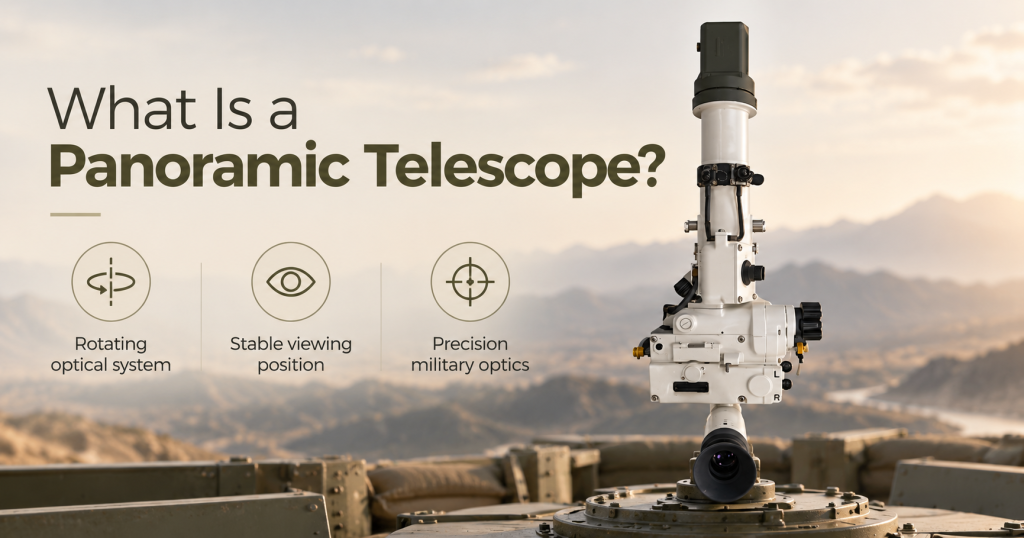
A panoramic telescope is a precision optical instrument that lets the user change the viewing direction horizontally through a rotating optical system while staying in a relatively stable viewing position.
Unlike a conventional telescope, the entire instrument does not always need to move with the line of sight. Instead, internal optical components redirect the image toward the eyepiece.
A typical system may include:
- Objective lens – collects incoming light
- Prisms – redirect the optical path
- Eyepiece – provides the viewing image
- Reticle – supports aiming or reference alignment
- Mechanical adjustment components – control rotation and positioning
- Precision housing – keeps the optical system aligned
These components work together to maintain a clear, correctly oriented image as the viewing direction changes.
Panoramic Telescope vs. Conventional Telescope
The main difference is how the line of sight is changed.
| Feature | Panoramic Telescope | Conventional Telescope |
| Viewing direction | Redirected through rotating optics | Entire telescope moves |
| Operator position | Remains relatively stable | Often moves with the instrument |
| Typical installation | Fixed or mounted optical systems | General observation |
| Main advantage | Controlled directional viewing | Simple direct viewing |
This design makes panoramic telescopes especially useful in fixed, mounted, and specialized optical systems.
How Does a Panoramic Telescope Work?
A panoramic telescope works by redirecting incoming light through a precisely aligned optical path.
Light enters through the objective lens, passes through internal prisms, and is directed toward the eyepiece. As the viewing head rotates, the optical system changes the line of sight while helping keep the image correctly oriented.
The exact design varies by model, but three factors have a major impact on performance:
Optical Alignment
Accurate optical alignment helps maintain image clarity and position.
Even small alignment errors can affect how the image appears as the viewing direction changes.
Mechanical Precision
Smooth and precise mechanical movement supports repeatable positioning.
The rotating structure must maintain stable alignment during operation. Excessive movement or looseness can reduce consistency.
Optical Component Quality
Lenses, prisms, reticles, and optical windows directly affect image quality.
Their quality can influence:
- Resolution
- Contrast
- Light transmission
- Image stability
- Overall optical performance
Because the optical and mechanical systems work together, precision manufacturing is a key part of panoramic telescope performance.
What Are the Key Features of a Panoramic Telescope?
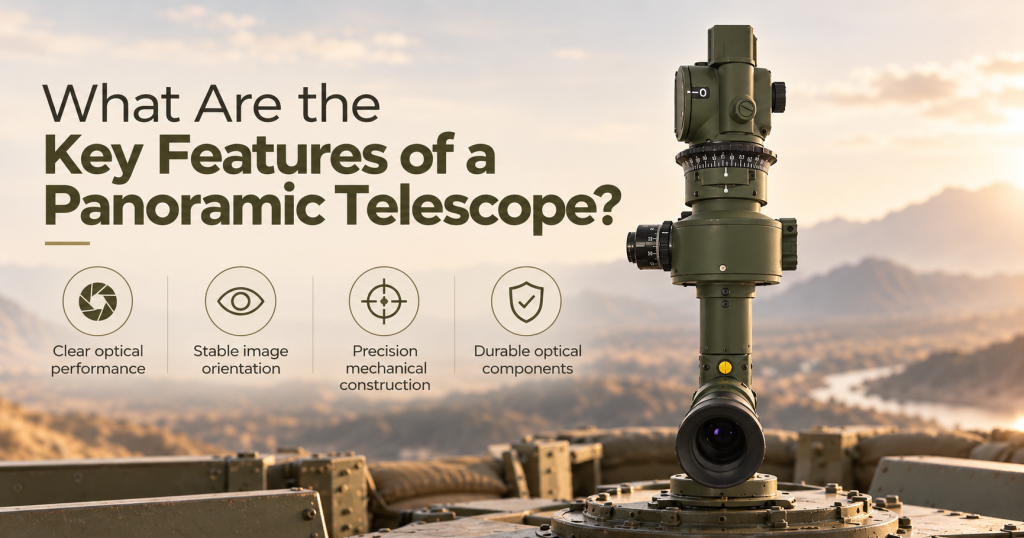
When choosing a panoramic telescope, magnification is only one part of the specification. Buyers should also consider optical clarity, mechanical accuracy, image orientation, and component quality.
1. Clear Optical Performance
A reliable optical system should provide clear images, good contrast, and consistent viewing performance.
The quality and alignment of lenses, prisms, and optical windows can affect both resolution and image clarity.
For professional applications, consistent performance across the usable viewing range is especially important.
2. Stable Image Orientation
Internal prisms help redirect the optical path while maintaining a usable and correctly oriented image.
This allows the operator to identify objects and reference points more easily as the viewing direction changes.
3. Precision Mechanical Construction
A panoramic telescope combines optical components with moving mechanical parts.
The rotating assembly therefore requires stable alignment, controlled movement, and consistent manufacturing tolerances.
Poor mechanical fit can affect both image stability and repeatability.
4. Durable Optical Components
Depending on the model, a panoramic telescope may include:
- Prisms
- Lenses
- Reticles
- Optical windows
- Mirrors or reflectors
- Mechanical housings
Each component contributes to the performance and reliability of the complete optical system.
Where Are Panoramic Telescopes Used?
Panoramic telescopes are mainly used in military optics, observation systems, and specialized fixed or mounted optical equipment.
Their rotating optical design is particularly useful when the operator needs controlled directional viewing without constantly repositioning the entire instrument.
Military Optical Systems
One of the most common applications is in military optical equipment.
A panoramic telescope may be integrated into a larger observation or sighting system where controlled directional viewing is required.
Different systems may use different:
- Optical configurations
- Reticles
- Mechanical interfaces
- Mounting designs
- Part specifications
Because of these differences, buyers should confirm the exact model, P/N, NSN, and system requirements before ordering a replacement.
Observation Equipment
Panoramic optical systems can also be used in specialized observation equipment.
Their ability to redirect the line of sight while maintaining a stable viewing position can be useful when the instrument is installed in a fixed or limited-space environment.
Legacy Optical Equipment
Older military and industrial systems may still depend on established optical designs.
In these cases, replacing a panoramic telescope is not always as simple as selecting a newer commercial model.
The correct replacement may need to match an existing:
- Model number
- P/N
- NSN
- Engineering drawing
- Physical sample
- Mechanical interface
This is why access to specialized optical manufacturing and customization can be important for legacy equipment.
Why Are NSN and P/N Important When Sourcing a Panoramic Telescope?
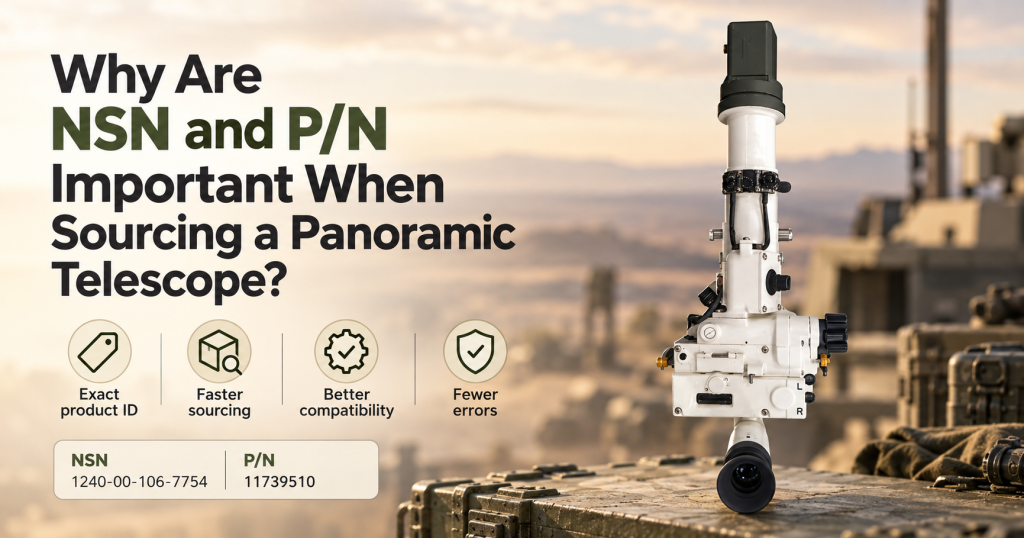
NSN and P/N help buyers identify the exact optical instrument or component required.
The term “panoramic telescope” describes a product category, but it does not always identify the exact configuration needed for a specific system.
What Is a P/N?
A Part Number (P/N) identifies a specific product, component, or configuration.
It helps manufacturers and procurement teams confirm that the requested item matches the required design.
What Is an NSN?
An NSN (National Stock Number) is a standardized identification number used for items within established government and defense supply systems.
It can help procurement teams locate and verify compatible equipment more efficiently.
What Information Should Buyers Provide?
When requesting a quotation or replacement, provide as much information as possible, including:
- Model number
- P/N
- NSN
- Engineering drawing
- Technical specifications
- Existing product sample
Accurate identification helps reduce sourcing errors, avoid compatibility issues, and shorten the quotation process.
OPTIS currently lists several products within its Panoramic Telescope Series, including the M100C, M12A7 Series, M115, and M117 Series, with P/N and NSN information available for applicable models.
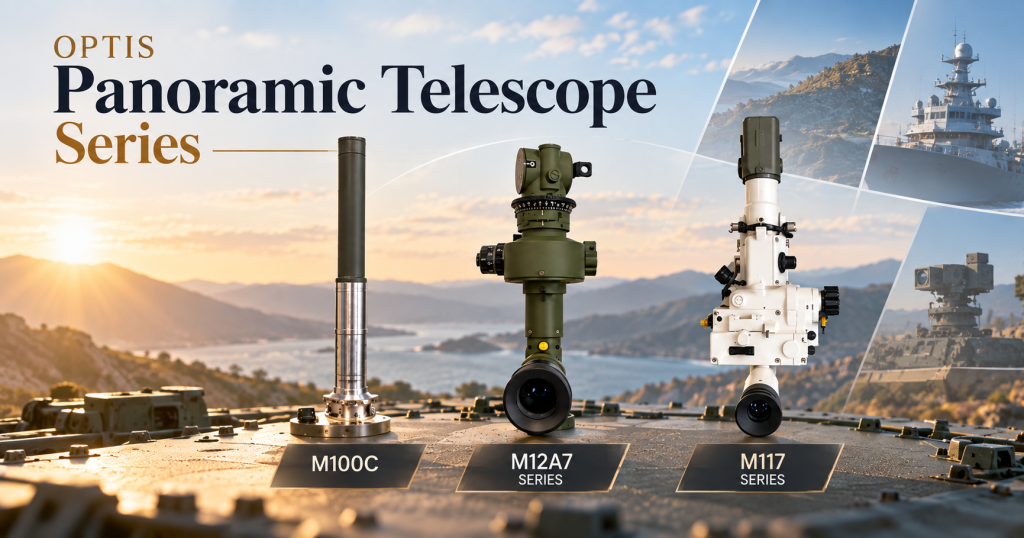
OPTIS Panoramic Telescope Series
OPTIS TECHNOLOGY offers a range of panoramic telescopes for professional military optical applications, including the M100C, M12A7 Series, M115, and M117 Series.
For procurement, replacement, or maintenance projects, the correct model can often be identified by its model number, P/N (Part Number), or NSN (National Stock Number).
| Model | P/N | NSN |
| M100C | — | 1240-00-344-4668 |
| M12A7 Series | Varies by configuration | Varies by configuration |
| M115 | 8587340 | 1240-00-895-9186 |
| M117 | 11739510 | 1240-00-106-7754 |
The M12A7 Series is available in several configurations, including M12A7C, M12A7D, M12A7H, M12A7K, M12A7S, and M12A7Q. Because specifications and product identifiers may vary between versions, confirming the exact configuration is important before placing an order.
Further Reading:Military Fire Control Equipment: Optical Components, Manufacturing & Procurement
How Do You Source the Right Panoramic Telescope?
The easiest way to source the correct panoramic telescope is to start with the information already available from the existing system.
When requesting a quotation, provide as many of the following details as possible:
- Model number
- P/N
- NSN
- Engineering drawing
- Technical specifications
- Existing product sample
- Optical requirements
- Mounting or interface dimensions
These details help determine whether an existing OPTIS model matches the requirement or whether a customized solution is needed.
For legacy military optical systems, the original model number or documentation may not always be available. In that case, an engineering drawing, dimensional information, or physical sample can help identify the required optical and mechanical specifications.
Providing clear product information early can help reduce compatibility issues, avoid sourcing errors, and make the quotation process more efficient.
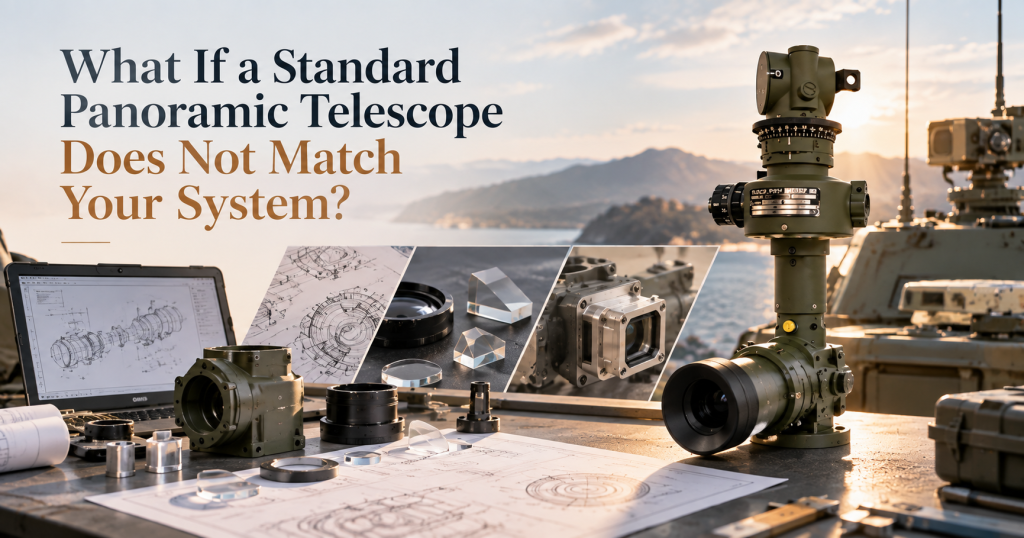
What If a Standard Panoramic Telescope Does Not Match Your System?
Not every optical requirement can be met with an off-the-shelf model.
Legacy equipment, replacement programs, OEM projects, and specialized optical systems may require different dimensions, optical configurations, reticles, mounting interfaces, or mechanical components.
In these cases, the supplier’s manufacturing and customization capabilities become just as important as the available product range.
OPTIS TECHNOLOGY has specialized in professional optical instruments since 1980, with capabilities covering:
- Military optical instrument manufacturing
- Telescope R&D and manufacturing
- Customized telescope manufacturing
- Optical component manufacturing
OPTIS also manufactures precision optical components such as lenses, prisms, reticles, optical windows, levels, mirrors, and reflectors.
This allows customers to source not only complete panoramic telescope systems, but also replacement units, customized configurations, and related optical components based on specific project requirements.
Find the Right Panoramic Telescope for Your Application
Need a panoramic telescope replacement, specific military optical model, or custom optical solution? Start with the information you already have.
Whether you have a model number, P/N, NSN, engineering drawing, technical specification, or existing sample, OPTIS can help evaluate your requirements and identify the right path forward.
With decades of experience in military optics, telescope manufacturing, and precision optical components, OPTIS TECHNOLOGY supports both standard products and customized solutions for specialized and legacy systems.
Contact OPTIS today to confirm compatibility, discuss your requirements, and request a quotation.
Panoramic Telescope FAQ
Q1: What is a panoramic telescope?
A panoramic telescope is a precision optical instrument that uses a rotating optical system to change the viewing direction while keeping the operator in a relatively stable position. It is commonly used in military optics, observation systems, and other mounted optical applications.
Q2: What information do I need when ordering a panoramic telescope?
Start with any available model number, P/N, NSN, engineering drawing, technical specification, or existing sample. These details help confirm compatibility, identify the correct replacement, or determine whether a custom optical solution is required.
Q3: Does OPTIS manufacture panoramic telescopes and custom optical systems?
Yes. OPTIS manufactures panoramic telescope models including the M100C, M12A7 Series, M115, and M117 Series. OPTIS also supports military optical instruments, customized telescope manufacturing, and precision optical components for standard, replacement, and specialized applications.